Should you buy an apartment or a villa in Dubai in 2026? For investors, this is not simply a question of choosing a smaller property or a larger one. Apartments and villas behave differently across Dubai’s residential market, and the right answer changes from one community to the next. As a general pattern, apartments tend to have lower total entry prices, a broader base of potential tenants and, in many communities, higher gross rental yields. Villas offer a different profile: more space, direct exposure to land, lower-density living, and in some markets, real scarcity and strong demand from families and end users. But there is no fixed rule that apartments always win on income or that villas always win on appreciation. Dubai’s 2026 data shows just how much this varies by location. In some communities, villa prices have significantly outpaced apartments over the past year. In others, apartments have shown stronger momentum. Even price per square foot does not consistently favour one property type over the other. A sound comparison needs to weigh purchase price, price per square foot, rental yield, recent price momentum, supply, tenant demand, resale liquidity and holding costs together, rather than relying on the words “apartment” or “villa” alone. Dirham figures below are also shown in US dollars for international readers, using the pegged rate of about 3.67 AED per dollar.
Apartment vs villa: a quick comparison
| Factor | Apartment | Villa |
|---|---|---|
| Typical total purchase price | Usually lower | Usually higher |
| Property size | Smaller | Larger |
| Land ownership component | Limited or none directly | Greater |
| Gross rental yield | Often higher | Often lower |
| Tenant pool | Broad | More family-focused |
| Service charges | Can be significant | Community and maintenance costs |
| Maintenance responsibility | Often simpler | Usually greater |
| Market liquidity | Strong in major apartment areas | Varies by villa community |
| New supply | Very high | More limited in many segments |
| Off-plan availability | Extensive | Growing but lower volume |
| Capital-growth driver | Location, project, demand, supply | Land scarcity, family demand, community quality |
| Best suited to | Income, liquidity, lower entry | Space, scarcity, longer-term ownership |
This table describes broad tendencies, not fixed rules. There are communities where villas trade below apartments on a price-per-square-foot basis, and others where villas command a substantial premium.
Price per square foot: not always what you expect
The first mistake many buyers make is comparing only total purchase price. A villa usually costs more in absolute terms simply because it is considerably larger and may include private land. Price per square foot tells a more complicated story.
| Community | Apartment AED/sq ft | Villa AED/sq ft |
|---|---|---|
| Dubai Hills Estate | 2,313 | 2,573 |
| JVC | 1,301 | 1,094 |
| JVT | 1,261 | 1,964 |
| DAMAC Hills | 1,347 | 1,793 |
| DAMAC Hills 2 | 1,057 | 878 |
| Al Furjan | 1,313 | 1,587 |
| Dubai South Residential District | 1,102 | 1,370 |
| Dubai Silicon Oasis | 956 | 1,298 |
| Dubai Sports City | 973 | 2,197 |
| Jumeirah Golf Estates | 1,567 | 2,235 |
| Living Legends | 1,022 | 1,567 |
| Meydan | 1,649 | 1,765 |
| Motor City | 1,004 | 1,718 |
| Rukan | 1,179 | 1,357 |
| Sobha Hartland | 2,019 | 2,705 |
| Wasl Gate | 1,467 | 1,526 |
The differences are substantial. In Dubai Sports City, villas were trading at more than twice the apartment price per square foot. In JVC and DAMAC Hills 2, however, villa price per square foot was actually lower than apartment pricing. This shows why buyers should not assume that “villa” automatically means a higher AED per square foot. Larger properties can trade at lower rates per square foot while still carrying a much higher total purchase price. Here’s why that happens. Imagine an apartment priced at AED 1.5 million for 1,000 sq ft, which works out to AED 1,500 per sq ft. A villa priced at AED 4 million for 4,000 sq ft works out to only AED 1,000 per sq ft. The villa is far more expensive in absolute terms but cheaper per square foot, because the buyer is purchasing a much larger area. Total ticket price and price per square foot are two different numbers, and neither should be evaluated alone. For a wider community breakdown, see our guide to Dubai property prices by area.
Rental yield: apartments generally come out ahead
One of the clearest differences between the two property types appears in rental yield. Across most communities where apartment and villa data are available separately, apartments currently generate the higher gross rental yield.
| Community | Apartment yield | Villa yield |
|---|---|---|
| DAMAC Hills 2 | 8.31% | 5.92% |
| Dubai Sports City | 8.09% | 3.61% |
| Rukan | 8.29% | 7.02% |
| Dubai Silicon Oasis | 7.60% | 4.28% |
| Living Legends | 7.85% | 3.57% |
| JVT | 7.41% | 3.73% |
| Motor City | 7.47% | 4.66% |
| DAMAC Hills | 7.36% | 5.24% |
| Dubai South | 7.25% | 4.40% |
| JVC | 7.21% | 5.89% |
| Wasl Gate | 6.96% | 5.42% |
| Sobha Hartland | 6.37% | 4.51% |
| Dubai Hills Estate | 6.30% | 4.42% |
| Jumeirah Golf Estates | 6.23% | 5.92% |
| Meydan | 5.61% | 5.09% |
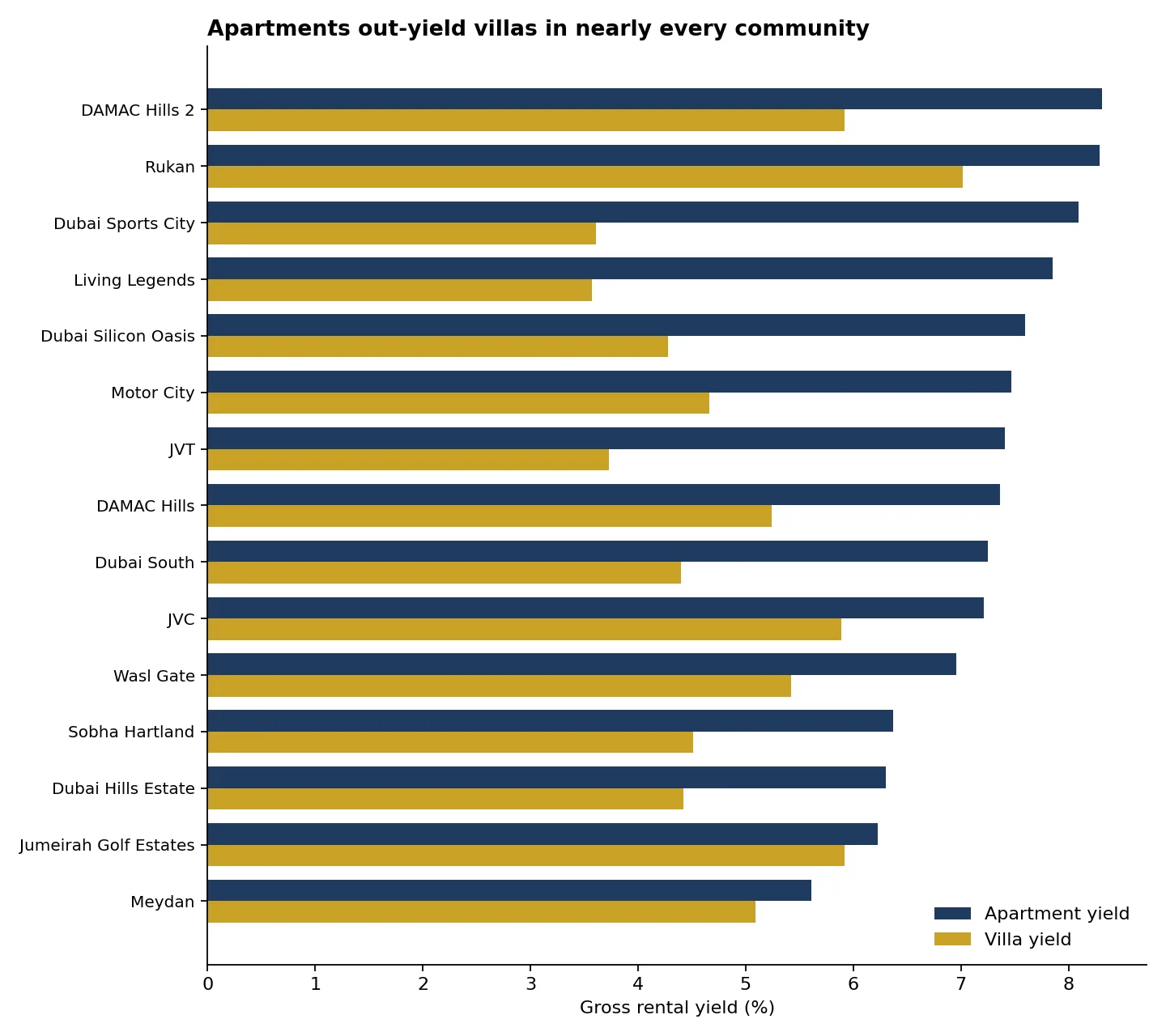
The pattern is consistent, but the explanation is not that tenants necessarily prefer apartments. It is mostly a matter of arithmetic: villa property values can rise much faster than the rent they can realistically command, and when value rises faster than rent, yield compresses. A simple example makes this clear. An apartment purchased for AED 1,000,000 renting at AED 80,000 a year produces a gross yield of 8%. A villa purchased for AED 4,000,000 renting at AED 200,000 a year produces a gross yield of 5%. The villa generates far more rent in absolute terms, but the investor has also committed four times more capital, so the apartment shows a higher return relative to its price. This is a major reason apartment-heavy communities dominate many rankings of the best rental yield areas in Dubai.
Does a higher yield mean a better investment?
Not necessarily. Rental yield is only one part of total return. Investors earn from two sources: rental income and capital appreciation. A villa yielding 4% can still outperform an apartment yielding 8% if the villa’s value grows fast enough, and a high-yield apartment can underperform if oversupply drags its capital value down. The right way to think about return is income plus capital growth minus costs, not simply the highest yield available.
Price growth in 2026: no consistent winner
Community-level data shows that neither apartments nor villas consistently outperform the other. The following comparisons illustrate just how different the two segments can be within the same location.
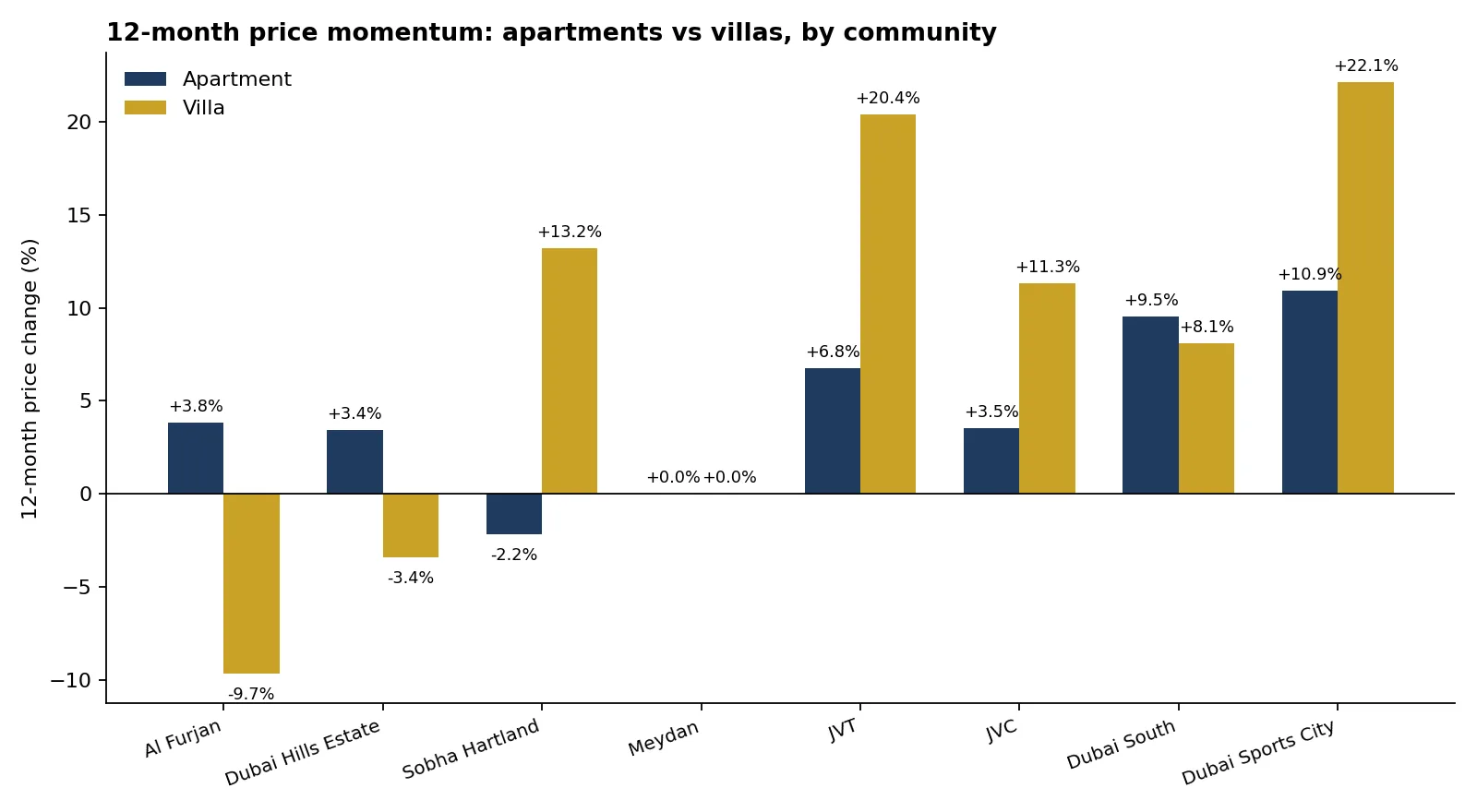
In Dubai Hills Estate, apartments rose 3.41% over 12 months but fell 3.29% over six months and 4.00% over three months. Villas fell 3.42% over 12 months, 5.21% over six months and 7.47% over three months. Apartments showed clearly greater resilience in this period.
In Dubai Sports City, the picture is almost reversed. Apartments rose 10.94% over 12 months, 6.83% over six months and 4.21% over three months. Villas rose even more, up 22.11% over 12 months, 12.61% over six months and 6.07% over three months. Both segments were positive, but villas recorded substantially stronger appreciation.
In Al Furjan, apartments gained 3.82% over 12 months, 2.33% over six months and 0.52% over three months, while villas fell 9.66% over 12 months, 6.18% over six months and 7.67% over three months. Here apartments materially outperformed villas, and buyers considering this community need to analyse the property type separately rather than relying on the neighbourhood’s name alone.
In Jumeirah Village Triangle, apartments rose 6.75% over 12 months but slipped 3.53% over six months and 5.07% over three months. Villas rose 20.38% over 12 months, 13.81% over six months and 4.40% over three months, showing much stronger momentum. A single community can therefore contain two very different property markets running at the same time.
Community deep dives
Dubai Hills Estate. Apartments average AED 2,313 per sq ft with a 6.30% gross yield, while villas average AED 2,573 per sq ft with a 4.42% yield. From an income perspective, apartments currently offer the stronger return. But the two segments serve different strategies: Dubai Hills villas attract family and end-user demand and offer exposure to a limited supply of large, low-density homes, while apartment investors are generally buying a more liquid, income-oriented asset. Neither can be judged on yield alone.
JVC. Jumeirah Village Circle is one of the most interesting comparisons in the data. Apartments average AED 1,301 per sq ft with a 7.21% yield and 12-month growth of 3.54%. Villas average AED 1,094 per sq ft, cheaper per square foot, with a 5.89% yield and much stronger 12-month growth of 11.30%. That is the unusual case of the cheaper-per-foot property type also showing the stronger price momentum, while apartments still deliver the better rental yield. It neatly illustrates two distinct strategies: an apartment investor prioritising income, a lower total entry price and a wider tenant market, against a villa investor prioritising space, scarcity and capital-growth potential.
Dubai Sports City. This community shows one of the widest gaps in the entire dataset. Apartments average AED 973 per sq ft with an 8.09% yield. Villas average AED 2,197 per sq ft, more than double the apartment rate, with a yield of only 3.61%, but villa prices also recorded much stronger annual appreciation. The two property types here are almost entirely different investment propositions: the apartment buyer accesses a relatively affordable, high-yield market, while the villa buyer is purchasing a scarcer, more expensive product with a lower income yield but stronger recent capital growth.
Dubai South. Dubai South apartments average roughly AED 1,102 per sq ft, a 7.25% yield and 12-month growth of 9.54%. Villas average about AED 1,370 per sq ft, a 4.40% yield and 12-month growth of 8.08%. Both segments are positive. Apartments currently offer stronger income, while villas provide exposure to larger family-oriented property in one of Dubai’s major long-term development areas. For a long-term investor, the decision may depend less on today’s yield and more on how the wider community matures.
Sobha Hartland. Apartments here average AED 2,019 per sq ft with 12-month performance of -2.16% and a 6.37% yield. Villas average AED 2,705 per sq ft with 12-month performance of +13.21% and a 4.51% yield. The villa segment showed considerably stronger capital growth while apartments produced the stronger rental yield, which is exactly why the apartment-or-villa question cannot be answered without first defining the investment objective.
Which type has more demand?
Both segments have been active during Dubai’s recent market expansion. In 2025, transaction growth was led by apartments, up about 21.7%, with villas close behind at about 20.5%; townhouses increased by roughly 6.6%. Both apartments and villas therefore participated strongly in the market’s growth. However, the composition of new supply is very different: apartments made up about 88.8% of newly launched units in 2025. That leaves an important distinction: apartment demand is large, but apartment supply is even larger, while villa markets can benefit from lower-density development and limited land availability in certain established communities.
Two different supply risks
Apartments have become the backbone of Dubai’s development pipeline, in part because an apartment tower can introduce hundreds of residential units on a relatively compact site, while villa communities require far more land. This creates different risks for each type of investor. An apartment investor faces competition from newly launched towers, future handovers, developer incentives and large numbers of similar units. A villa investor typically faces fewer directly comparable properties, but higher absolute prices and a smaller pool of potential buyers. Supply should be analysed differently for each property type rather than assumed to behave the same way.
Are villas actually scarce?
In many communities, yes, but scarcity has to be judged at the level of the specific community and property, not the word “villa” itself. A generic townhouse in a large, still-developing master community is not necessarily scarce. An upgraded villa on a large plot in an established, low-density community can be genuinely difficult to replace. Communities where scarcity tends to matter more include The Meadows, The Lakes, Jumeirah Islands, Jumeirah Park, established parts of Arabian Ranches, and certain Palm Jumeirah villa segments. The investment value comes from the limited supply of that particular asset, not from the property type label.
Liquidity: usually favours apartments, but not always
Apartments generally benefit from a larger pool of potential buyers because their total purchase prices are lower. A one-bedroom apartment worth AED 1.5 million is accessible to far more buyers than a villa worth AED 8 million, which tends to improve transaction liquidity. But this is not universal. Highly desirable villas in established communities can have excellent liquidity when available inventory is limited, while an apartment in a building with hundreds of near-identical listings can face intense competition when it comes time to sell. The key question for either type is how many comparable properties will compete with yours when you eventually sell.
Who rents apartments, and who rents villas?
Apartment tenant demand tends to be broader, drawing individuals, couples, professionals, small families and short- to medium-term residents. Studios, one-bedroom and two-bedroom units are especially important parts of Dubai’s rental and transaction markets. Investors can compare current stock through apartments for sale in Dubai. Villa demand, by contrast, is more closely tied to households seeking extra bedrooms, private outdoor space, privacy, nearby schools, community amenities and a long-term family home. This can produce a relatively sticky tenant and end-user base, since families may stay longer than tenants in smaller apartments, reducing turnover for investors. The trade-off is that villa maintenance responsibilities and absolute repair costs can be higher. You can browse villas for sale in Dubai to compare current listings.
Operating costs: service charges versus maintenance
Operating costs matter when comparing net returns. Apartments typically carry service charges covering building management, security, lifts, swimming pools, gyms, common areas and general building maintenance, and high-end towers can carry substantial annual charges that directly reduce net yield. Villas can also have community charges, but owners usually carry more direct responsibility for the physical property, including landscaping, air-conditioning systems, plumbing, roofing or waterproofing, external maintenance, private pools and larger-scale repairs. Investors should compare net ownership cost, not just gross rental yield, and those managing remotely may want to factor in the cost of professional property management services.
Off-plan: apartment or villa?
The distinction becomes even more important off-plan. Apartment supply has expanded dramatically, so an off-plan apartment buyer needs to think carefully about how much competing inventory may be delivered before or around handover. Villa launches exist too, but they represent a much smaller share of new unit supply, which can support scarcity, though off-plan villa projects usually involve much larger purchase commitments. Either way, compare launch price per square foot, the payment plan, the handover date, future supply, expected rent and comparable ready property before committing. Our guide to off-plan versus ready property in Dubai covers this in more depth.
What actually drives capital growth
Capital appreciation depends less on whether a property is an apartment or a villa, and more on scarcity, demand, acquisition price and future supply. An apartment in a genuinely scarce waterfront location can outperform a villa in an oversupplied peripheral community, and a villa in a mature family community with almost no new land can outperform a generic apartment tower. Simplistic rules such as “villas always appreciate more” or “apartments are always better investments” are not supported by the current community data.
One villa or several apartments?
Suppose an investor has AED 5 million ($1.36 million) to deploy. They could buy one villa, or several smaller apartments instead. Multiple apartments offer diversification: if one unit sits vacant, the others can keep generating income, though managing several properties adds operational complexity. A single villa is simpler to manage as one asset but concentrates capital in a single property. There is no universally correct answer; it depends on the investor’s risk tolerance and objectives.
Choosing between the two
An apartment strategy tends to suit buyers who prioritise a lower entry price, a high gross rental yield, broader tenant demand, transaction liquidity and the ability to diversify across several properties. A villa strategy tends to suit buyers who prioritise land and low-density exposure, family or end-user demand, scarcity, the potential for larger long-term capital gains in selected communities, and value-add through renovation. These are starting points, not rules; every property still needs to be evaluated on its own.
A better framework than “apartment or villa”
Rather than asking whether apartments or villas are better in Dubai, ask a more useful set of questions: What is the actual acquisition price? What have comparable properties recently sold for? What is the realistic rent? What is the net rental yield after costs? How much competing supply is coming? Who is the likely future buyer? What gives this particular property scarcity? And what happens to the investment if price growth stalls for several years? If the numbers still make sense after answering these, the property type becomes a secondary consideration.
Is there a universal winner in 2026?
The 2026 data does not support one. Apartments currently offer stronger gross rental yields across many comparable communities and generally require less capital to enter. Villas can offer greater exposure to scarcity, land and family-oriented demand, and selected villa communities continue to show strong capital appreciation. Both segments carry risk: Dubai’s apartment market faces a substantial pipeline of new supply, while villa buyers face larger absolute purchase commitments and lower rental yields in many locations. The best investment sits at the intersection of community, property type, price, yield, supply and liquidity, and the market increasingly rewards careful asset selection over broad assumptions.
Frequently asked questions
Is it better to buy an apartment or villa in Dubai? Neither is universally better. Apartments often provide higher rental yields and lower entry prices, while villas may offer greater scarcity and stronger family or end-user demand. The right choice depends on the individual property and your investment objective.
Do apartments have higher rental yields than villas in Dubai? In most major communities where separate data exists, yes. Dubai Sports City apartments generate about 8.09%, for example, compared with about 3.61% for villas.
Do villas appreciate faster than apartments in Dubai? Not consistently. Dubai Sports City and JVT showed strong recent villa performance, while Dubai Hills Estate and Al Furjan showed stronger apartment resilience over the same period.
Are villas always more expensive per square foot? No. JVC apartments averaged about AED 1,301 per sq ft, compared with about AED 1,094 per sq ft for villas in the July 2026 community data. Villas still typically carry a higher total price because they contain far more space.
Are apartments easier to rent in Dubai? Apartments generally benefit from a larger and more varied tenant pool, particularly studios, one-bedroom and two-bedroom units, though villa communities can have strong family demand and longer tenancies.
Which property type is better for rental income? Apartments currently provide stronger gross rental yields across many comparable communities. Always calculate net yield after service charges, maintenance, vacancy and management costs.
Is a villa more expensive to maintain? Often, yes. Villa owners may be responsible for larger-scale maintenance, landscaping, external areas and private systems, while apartment owners typically pay service charges that cover shared facilities and building operations.
Should I buy one villa or multiple apartments? Multiple apartments can offer more diversification and potentially higher combined rental yield, while a single villa can offer greater scarcity and simpler portfolio management. The right approach depends on your available capital and risk tolerance.
Compare before you buy
The choice between an apartment and a villa should never rest on a general market rule. Dubai contains dozens of distinct residential submarkets, and an apartment can outperform a villa in one community while the opposite happens only a few kilometres away. The strongest decisions start with the numbers: purchase price, price per square foot, rental yield, recent transactions, future supply and resale liquidity, compared before you select a property. Browse apartments for sale in Dubai, compare Dubai villas, explore townhouses, or contact California Properties to compare opportunities that match your investment strategy.