
Which type of property sells the most in Dubai? The 2026 transaction data gives a clear answer: the one-bedroom apartment.
Between 1 January and 31 August 2026, about 35,026 one-bedroom properties changed hands in the bedroom-classified dataset. Studios came second with 26,299 transactions, followed by two-bedroom properties with 20,301. Together, these three unit types made up roughly 80.7% of all bedroom-classified sales, which shows how central smaller homes are to Dubai’s market. But transaction count is only half of the story. When the same market is measured by total sales value, the picture changes. Properties with three bedrooms or more accounted for only about 19.3% of transactions, yet they generated roughly 53.1% of total sales value. In other words, Dubai runs on two demand stories at once. Smaller units dominate volume and liquidity, while larger homes hold a disproportionate share of the capital. This guide looks at what sold in the first eight months of 2026, and what it means for buyers, investors and sellers.
Dubai property demand by bedroom: the full picture
The dataset covers 101,168 bedroom-classified transactions with a combined value of about AED 262.76 billion (roughly $71.5 billion). Because the dirham is pegged to the US dollar at about 3.67, the average prices below are also shown in dollars for international readers.
| Bedrooms | Transactions | Share of transactions | Total value | Share of value | Average price | Approx. USD | Avg. AED per sq ft |
|---|---|---|---|---|---|---|---|
| Studio | 26,299 | 26.0% | AED 19.09B | 7.3% | AED 725,909 | $198K | 1,815 |
| 1 bedroom | 35,026 | 34.6% | AED 50.55B | 19.2% | AED 1.44M | $393K | 1,838 |
| 2 bedrooms | 20,301 | 20.1% | AED 53.72B | 20.4% | AED 2.65M | $722K | 1,989 |
| 3 bedrooms | 8,400 | 8.3% | AED 39.82B | 15.2% | AED 4.74M | $1.29M | 2,031 |
| 4 bedrooms | 7,320 | 7.2% | AED 45.89B | 17.5% | AED 6.27M | $1.71M | 1,688 |
| 5 bedrooms | 3,126 | 3.1% | AED 33.05B | 12.6% | AED 10.57M | $2.88M | 1,844 |
| 6 bedrooms | 610 | 0.6% | AED 17.50B | 6.7% | AED 28.69M | $7.81M | 2,698 |
| 7 bedrooms | 76 | 0.08% | AED 3.08B | 1.2% | AED 40.55M | $11.0M | 2,883 |
Categories from eight to ten bedrooms are left out of the table because their samples are tiny: eight transactions for eight-bedroom homes and just one each for nine and ten bedrooms. An average built from one or eight sales is not a reliable benchmark, so those figures should be read as individual observations rather than typical prices for very large Dubai homes.
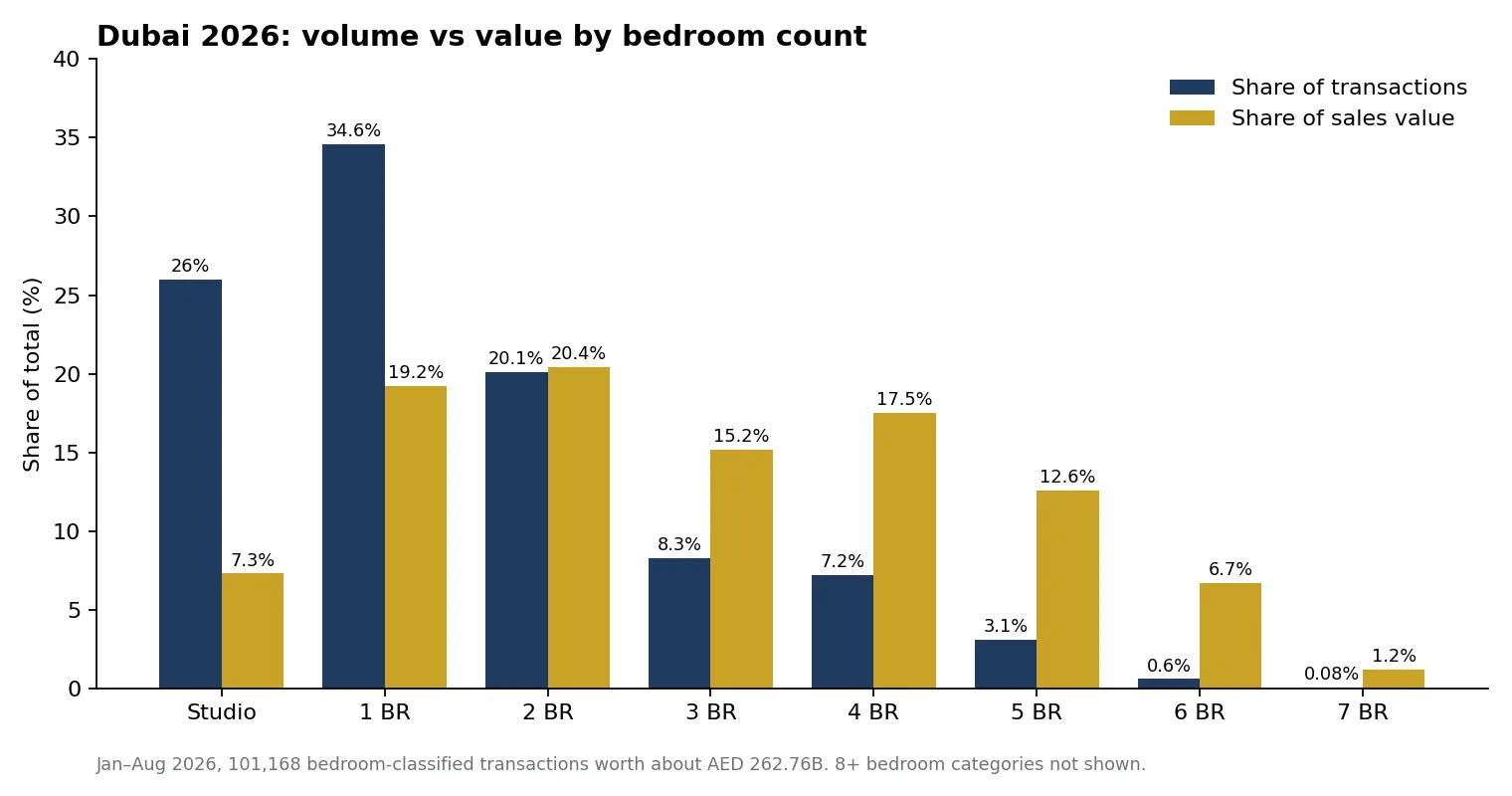
The one-bedroom is Dubai’s volume leader
One-bedroom units recorded 35,026 transactions worth about AED 50.55 billion, or 34.6% of the bedroom-classified market. Roughly one in every three sales in this dataset involved a one-bedroom property. The average deal was about AED 1.44 million ($393,000) at around AED 1,838 per square foot. There are good reasons why this unit type is so popular. A one-bedroom sits at the meeting point of several buyer groups: individual residents, couples, investors, long-term tenants, owners moving up from studios, and buyers who want a lower ticket than a two-bedroom. That mix combines a relatively accessible price with a broad use case, steady rental demand and a large pool of future resale buyers. Depth matters for anyone who plans to sell one day. A segment with more than 35,000 transactions gives buyers and sellers plenty of comparable sales, which makes prices easier to judge. It is a very different environment from the seven-bedroom segment, where only 76 deals took place. That said, a busy segment does not mean every one-bedroom is easy to sell. Building quality, community, developer and purchase price still decide how attractive an individual apartment is. A one-bedroom is not scarce simply because one-bedrooms are popular across the city.
Studio or one-bedroom: which has more demand?
Studios recorded 26,299 transactions, so one-bedrooms generated about one-third more. The price gap is large: the average studio sold for AED 725,909, while the average one-bedroom sold for AED 1,443,208, almost twice as much. The result is telling. Buyers did not simply gravitate to the cheapest product. They completed far more one-bedroom deals despite a much higher ticket, which suggests that the extra room and living space carry real weight in the market. Studios nevertheless remain a huge segment, at around 26% of transactions. They offer one of the lowest entry points into Dubai property, which suits first-time investors, smaller budgets, rental-income strategies and portfolio diversification. But a low ticket price does not mean low risk. Studio-heavy developments can face intense competition when many near-identical units reach the market at once.
Two-bedrooms generate the most sales value
The most interesting result appears when we move from counts to value. Two-bedroom properties did not record the most deals: their 20,301 transactions trail the one-bedroom segment by a wide margin. Yet they produced the largest total sales value of any bedroom category, at AED 53.72 billion, slightly ahead of the one-bedroom market. The average two-bedroom sold for about AED 2.65 million ($722,000), at roughly AED 1,989 per square foot. This makes the segment especially important for developers and investors, because it combines fairly high volume with much bigger ticket sizes and strong appeal to families and end users. Put one- and two-bedrooms together and they account for about 55,300 transactions, or 54.7% of the market, and nearly 40% of total sales value. Add studios, and the three smallest categories represent more than 80% of all transactions. This explains why apartment-led developments continue to play such a large role in Dubai. You can compare current apartments for sale in Dubai across different communities and price points.
Larger homes: fewer sales, much higher tickets
Once bedroom counts rise to three and above, transaction numbers fall sharply while prices climb. Three-bedroom properties recorded 8,400 transactions, or 8.3% of the market, but generated AED 39.82 billion. The average sale was about AED 4.74 million ($1.29 million), at around AED 2,031 per square foot. The buyer pool is smaller than for one- or two-bedrooms, but each deal carries far more value. Four-bedroom properties tell an even sharper story. With 7,320 transactions, or just over 7% of volume, they still generated about AED 45.89 billion, or 17.5% of total sales value. The average price was AED 6.27 million ($1.71 million). There are far fewer four-bedroom buyers than one-bedroom buyers, but the money involved in each deal is much larger. Five-bedroom homes sold 3,126 times for a total of about AED 33.05 billion, at an average of AED 10.57 million ($2.88 million). They represent only 3.1% of transactions but 12.6% of sales value, which reflects the growing weight of villas and luxury homes as bedroom counts rise. If you are looking at larger family homes, compare villas for sale in Dubai and townhouses separately from apartments. From six bedrooms upward, the market becomes a different world. Six-bedroom homes recorded just 610 transactions but generated about AED 17.50 billion, averaging AED 28.69 million. Seven-bedroom homes recorded only 76 transactions, yet they were worth more than AED 3 billion, at an average of AED 40.55 million. These segments serve a very small luxury and ultra-luxury buyer pool and should not be compared directly with ordinary apartment categories.
Volume and value tell opposite stories
The clearest way to see Dubai’s structure is to compare the two halves of the market side by side.
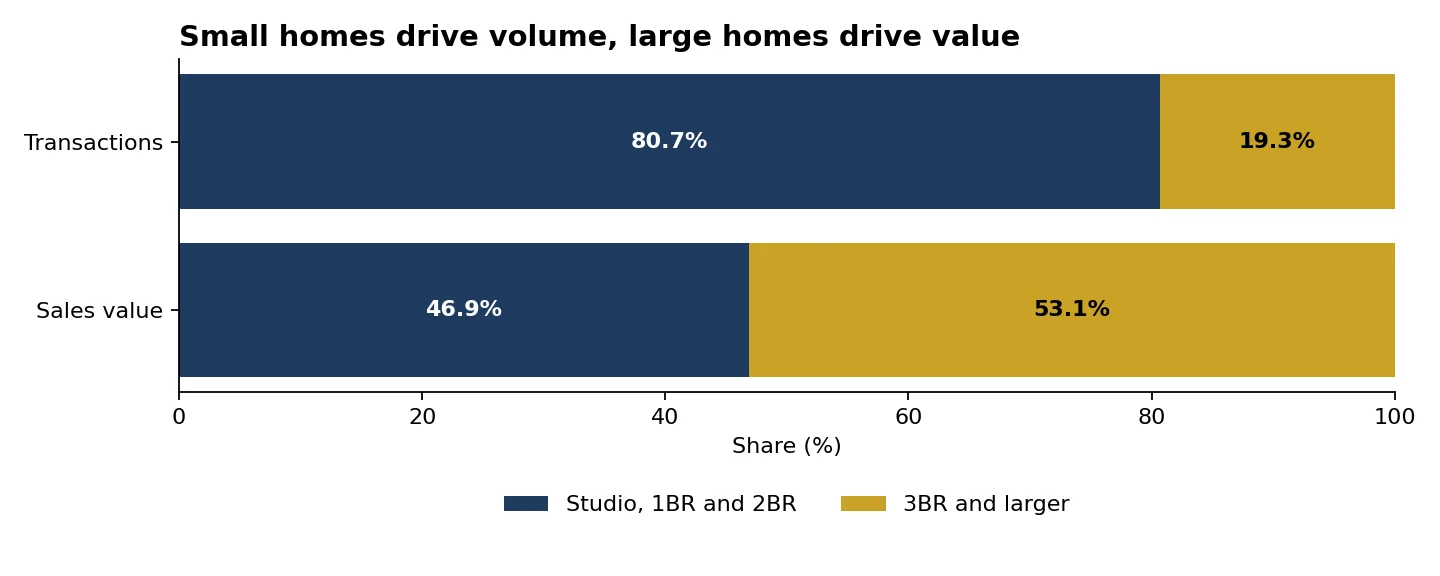
Dubai’s smaller-unit market provides transaction depth, while its larger-home market provides capital concentration. Investors should know which side of the market they are entering, because the two behave differently when it comes to pricing evidence, resale timing and the size of the buyer pool.
Why transaction count matters, and where it falls short
Transaction activity is not a perfect measure of liquidity, but it is useful evidence of market depth. A segment with tens of thousands of sales tends to have more buyers, more sellers and more comparable deals, which makes price discovery easier and gives valuers more to work with. However, high volume does not guarantee good returns. A liquid apartment market can still suffer from heavy future supply, weak rent growth, aggressive competition between developers or falling prices. Meanwhile, a scarce villa segment can see few transactions and still deliver strong capital appreciation. Volume should therefore be weighed together with price momentum, rental yield, supply and your purchase price. Our guide to the best areas to invest in Dubai looks at these factors together.
How size changes with bedroom count
Property Monitor’s wider inventory data shows how quickly built-up area grows as bedrooms are added.
| Bedrooms | Average built-up area |
|---|---|
| Studio | 451 sq ft |
| 1 bedroom | 943 sq ft |
| 2 bedrooms | 1,656 sq ft |
| 3 bedrooms | 2,332 sq ft |
| 4 bedrooms | 4,183 sq ft |
| 5 bedrooms | 7,383 sq ft |
A typical five-bedroom home is not just a slightly larger two-bedroom. It sits in an entirely different size and price category. Figures for six bedrooms and above should be treated with caution because the underlying samples are very small.
Choosing between unit types
Studio versus one-bedroom. Studios offer the lower entry point, while one-bedrooms have the larger observed transaction market. The better investment depends on rental yield, service charges, purchase price, community, future supply and resale competition. A studio with excellent economics can easily outperform an overpriced one-bedroom, so unit type should never replace property-level analysis.
One-bedroom versus two-bedroom. Both segments are liquid. The one-bedroom has the larger pool of transactions, at 35,026 deals and an average of AED 1.44 million. The two-bedroom generates more total value, at AED 53.72 billion and an average of AED 2.65 million, and may attract a broader family and end-user market. An investor should ask whether the extra capital needed for a two-bedroom is repaid through higher rent, stronger tenant retention and growth potential.
Two-bedroom versus three-bedroom. The jump is substantial. The average price rises from AED 2.65 million to AED 4.74 million, while transactions fall from 20,301 to 8,400. That points to a much smaller buyer pool as the ticket grows, which means less transaction depth but more exposure to family and premium housing demand.
Bedroom count is not the same as property type
This distinction is essential. A three-bedroom sale can be an apartment, a townhouse, a villa, a penthouse or another residential configuration. The dataset measures unit configuration, not legal property type. Investors deciding specifically between apartments and villas should read our Apartment vs Villa in Dubai 2026 comparison. Bedroom count is also not a measure of investment quality. It would be wrong to conclude that the one-bedroom is the best investment because it sells the most. The data supports a narrower claim: the one-bedroom is the most actively traded bedroom segment in the current dataset. A good investment combines a sensible purchase price, rental demand, manageable supply, reasonable service charges, an attractive yield, strong building quality and enough resale liquidity.
Which unit type is best for rental income or resale?
The bedroom dataset alone cannot tell you which unit type earns the best rent. To calculate a return, you need both the purchase price and the achievable annual rent, which is why community-level yield is often more useful than bedroom count. The most frequently sold unit is not necessarily the highest-yielding one. For income-focused buyers, our guide to the best rental yield areas in Dubai is a better starting point. On resale, studios, one-bedrooms and two-bedrooms have the largest observed markets, which can help when it is time to sell. But resale liquidity is local. A desirable four-bedroom villa in a supply-constrained community may sell more easily than a generic one-bedroom in an oversupplied tower. Investors should look at both citywide segment liquidity and competition at project level.
Demand follows budget
Bedroom demand closely mirrors the structure of Dubai’s price market. Average prices rise from AED 726,000 for a studio to AED 1.44 million for a one-bedroom, AED 2.65 million for a two-bedroom, AED 4.74 million for a three-bedroom, AED 6.27 million for a four-bedroom and AED 10.57 million for a five-bedroom. As the capital requirement rises, the pool of potential buyers shrinks, which is a major reason smaller units generate far higher volumes. For a breakdown by purchase price, read our Dubai Property Market by Budget 2026 guide.
What the numbers mean for developers, sellers and buyers
For developers, the data helps explain why new launches remain so apartment-driven. Studios, one-bedrooms and two-bedrooms give access to the deepest part of the market and allow lower individual ticket prices than large family homes. But strong demand does not remove supply risk. If many developers deliver similar one-bedrooms in the same location, buyers have plenty of choice and competition between projects intensifies. For sellers, a one-bedroom owner has access to a large buyer pool but also faces many competing listings. A villa owner may have fewer potential buyers, yet if the home is genuinely scarce, direct competition may be limited. The right asking price depends on demand relative to competing supply, not on transaction volume alone. For buyers, the data shows where the market is deepest, but the biggest crowd is not always the best guide. High-volume segments offer better comparable sales, more liquidity and more project choice. Lower-volume segments can offer scarcity, fewer direct substitutes and stronger differentiation. The right answer depends on your strategy.
Does off-plan activity distort the picture?
To some extent, yes. Dubai’s transaction market has a large off-plan component, and new developments are often concentrated in apartment configurations, which influences the observed bedroom mix. The data is therefore not a pure survey of what residents want. It reflects what was available, launched, purchased and registered during the period. Buyers weighing new developments against completed homes can read our guide to off-plan versus ready property in Dubai.
How to use bedroom data wisely
Treat bedroom data as a screening tool. If you prioritise liquidity, start with the one- and two-bedroom markets. If you want the lowest entry price, studios offer the smallest average ticket. If family demand matters most, two- and three-bedrooms become increasingly relevant. If you value scarcity and luxury exposure, larger homes may suit you better, though transaction depth is much lower. Then move from the citywide picture to the individual community and project. Instead of asking which bedroom type is best, ask how many comparable units exist, what the property costs, what rent it can realistically achieve, what the net yield would be, how many similar units are under construction, how many comparable properties sold recently, who will rent it and who will buy it from you later. That framework is far more useful than bedroom count on its own.
Frequently asked questions
What is the most popular property size in Dubai in 2026? By transaction count, one-bedroom properties were the most actively traded segment from January to August 2026, with about 35,026 transactions.
Do studios or one-bedroom apartments sell more? One-bedrooms. There were about 35,026 one-bedroom transactions compared with 26,299 studio transactions.
Are two-bedroom apartments popular in Dubai? Yes. They recorded about 20,301 transactions and generated the highest total sales value of any bedroom category, at roughly AED 53.72 billion.
What share of transactions are studios, one-bedrooms and two-bedrooms? Together, they accounted for about 80.7% of bedroom-classified transactions in the January–August 2026 dataset.
What are the average prices by bedroom? About AED 1.44 million for a one-bedroom, AED 2.65 million for a two-bedroom and AED 4.74 million for a three-bedroom. Actual prices vary widely by community and project.
Do larger homes make up most of Dubai’s sales value? Yes. Homes with three or more bedrooms represented about 19.3% of transactions but roughly 53.1% of total sales value.
Does higher transaction volume mean better investment performance? No. High volume can indicate deeper liquidity, but returns also depend on price, rental yield, future supply and asset quality.
Find the right unit type for your Dubai property strategy
Dubai’s 2026 data shows a market that is not evenly spread across property sizes. One-bedrooms lead on transaction volume, two-bedrooms lead on total sales value, studios remain a major entry-level market, and larger homes hold a disproportionate share of capital despite far fewer sales. The right unit depends on what you want from your investment.
Before choosing, compare your budget, bedroom count, community, rental yield, supply, liquidity and purchase price. You can browse Dubai apartments for sale, explore villas and townhouses, compare Dubai communities, or contact California Properties to find the unit type that fits your goals.